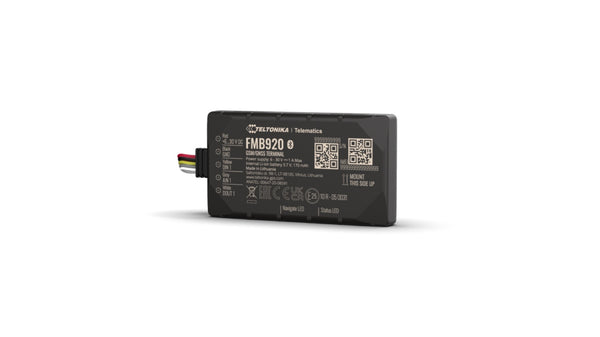
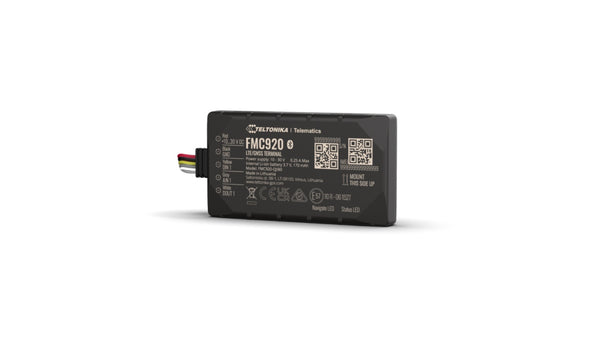
If you are choosing between the FMC920 (4G) and the FMB920 (2G) for your fleet, here is the short answer: FMC920 if you want future-proofing and real-time data; FMB920 if budget rules and 2G coverage works for you.
The most important difference between the two models is not GPS performance — they use the same GNSS module and the same sensors. What changes is cellular connectivity, and that affects data reporting frequency, latency, power consumption and product lifespan.
Key differences (summary table)
| Criterion | FMC920 (4G LTE Cat 1) | FMB920 (2G GSM) |
|---|---|---|
| Cellular connectivity | 4G LTE Cat 1 + 2G fallback | 2G GSM (no 4G fallback) |
| Data upload speed | ~5 Mbps | ~85 kbps |
| Typical latency | 50-100 ms | 300-500 ms |
| Recommended reporting frequency | Every 10-30 seconds | Every 60-120 seconds |
| Average consumption (running) | ~80-120 mA | ~50-80 mA |
| Spain coverage 2026+ | 4G LTE (operational until 2035+) | 2G (shutdown announced 2025-2030 by operator) |
| Trackiber price (RRP inc. VAT) | 55 € | 49 € |
| Ideal for | Active fleets, renting, anti-theft | Large fleets with tight budget |
When to choose FMC920 (4G)?
We recommend the FMC920 if:
- Your management platform needs positions every 10-30 seconds (corporate renting, car-sharing, last-mile logistics).
- You will integrate the device with a server that receives many events per minute (additional sensors, CAN bus combined with an FMC130).
- You want future-proofing: 2G will be switched off in Spain between 2026 and 2030 depending on operator (Movistar, Vodafone, Orange already have public roadmaps). The FMC920 has 4G as primary and 2G as fallback, so it survives the shutdown.
- You need low latency for critical alerts (motion, tampering, door opening) — the 2G delay can be problematic in fleets with high demands.
When to choose FMB920 (2G)?
We recommend the FMB920 if:
- Your fleet is large (50+ vehicles) and budget rules. The 6 € difference per unit over 50 vehicles is 300 € — and the FMB920 is good enough for basic tracking.
- You only need position every 1-2 minutes. For a fleet of delivery vans on a normal route, 60 seconds is enough.
- Your management platform is light (self-hosted Traccar, GpsGate) and does not process massive event streams.
- You operate in rural or international zones where 2G coverage beats 4G (some EU countries still have better 2G in mountainous areas).
What changes for CAN bus data
Both models can be combined with external adapters (LV-CAN200, ALL-CAN300, CAN-CONTROL) to read OEM vehicle data. CAN compatibility is identical between the two — it depends on the car bus, not on tracker connectivity. If your priority is CAN bus, both work.
That said: for native integrated CAN, neither of them is the option. For that you need the FMC150 (4G native CAN) or the FMC130 (4G Advanced + external CAN-CONTROL).
Platform compatibility
Both FMC920 and FMB920 speak the Teltonika Codec 8 and 8E protocols, so they are compatible with all commercial platforms (Wialon, Traccar, Flespi, GpsGate, Fleet Complete) and with custom developments via JSON API. The choice does not affect integration.
Warranty and installation
Identical: both ship with 24 months of official Teltonika warranty + 3 years of legal warranty for individual consumers. Installation is the same: direct wiring to 12/24V (red permanent positive, black ground, orange ignition), with the option to add digital inputs/outputs for alarm, immobiliser or additional sensors.
Final recommendation
If you do not have a clear reason to go 2G (extreme budget + large fleet + basic tracking), choose the FMC920. The 6 € difference per unit will be recovered when you avoid replacing 50 devices once 2G is switched off in 2-4 years.
If you go with 2G, buy before Q2 2027 — operators are announcing the shutdown and 2G devices will lose resale value.
Unsure about your specific case? We have a 2-question wizard that recommends the exact device at /pages/asesoramiento. Or message us on WhatsApp at +34 630 88 28 19 — you will get a reply from someone who fits these devices every day.